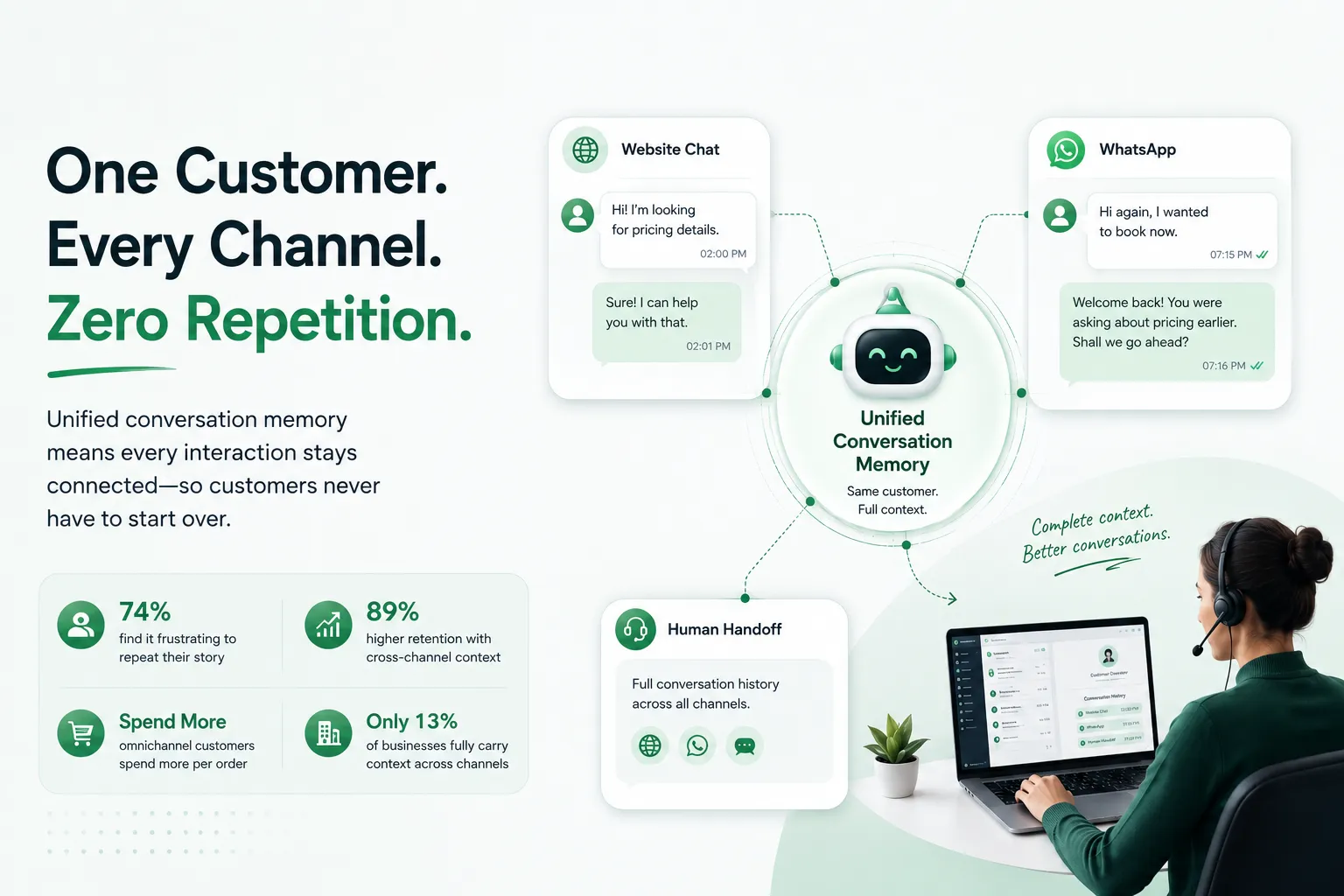
"Omnichannel" is one of the most overused words in customer experience. Unified conversation memory actually means a customer who starts on your website and finishes on WhatsApp never has to repeat themselves. Most businesses fail that test without realizing it, operating siloed channels instead.
The problem is bigger than most teams think
The stat that should worry every business running separate tools for web chat, WhatsApp, and phone support: 74% of consumers say it's frustrating to repeat their story to different agents, and 56% say they've actually had to do it because their channels weren't connected. Even more telling — only about 13% of businesses fully carry customer context across channels. Everyone else is running what looks like omnichannel from the outside, and feels like starting over from the inside.
This isn't a minor UX annoyance. It shows up directly in retention numbers: businesses that get cross-channel context right retain roughly 89% of customers, compared to 33% for businesses running disconnected, siloed channels — a 56-point gap. Omnichannel-first customers also spend measurably more per order than single-channel ones. The businesses getting this right aren't winning on a nicer chat widget. They're winning because they've eliminated a specific, well-documented source of customer frustration that most of their competitors haven't touched.
Why this keeps happening even when businesses "have" multiple channels
Having a website chat widget and a WhatsApp number and a phone line isn't the same as having omnichannel support. In practice, most setups look like this:
- The website chatbot runs on one tool, with its own conversation log
- WhatsApp is handled through a separate automation platform, or a different inbox entirely
- Phone calls go to whoever picks up, with no written record beyond a call log
- None of these three systems know what happened in either of the other two
So when a prospect messages your website at 2pm asking about pricing, doesn't convert, and messages your WhatsApp number that evening to actually book — from the business's side, that's two unrelated conversations with a stranger who happens to ask a similar question twice. From the customer's side, it's the exact frustration the research above is measuring: I already told you this.
What "unified memory" actually requires
Genuine cross-channel continuity isn't a feature you bolt onto separate tools after the fact — it has to be architectural. A conversation started on one channel needs to be readable, in full, by whatever channel the customer picks up on next: same identity resolution, same conversation history, same understanding of what's already been asked and answered.
This is the specific problem Frosty Agent is built around. The web and WhatsApp agents share a single memory by design — not a synced log reviewed later, but the same underlying conversation state. If someone starts a chat on your site and picks it up on WhatsApp an hour later, Frosty already knows what was discussed. They don't repeat their question, and your team doesn't get two disconnected leads to reconcile into one.
The same principle carries through to the human handoff. When a conversation gets escalated to your team, whoever takes it over sees the entire history — every channel, every message — not just whatever came in on the channel they happen to be watching.
What to actually check in your own setup
If you're not sure whether your current setup is genuinely omnichannel or just multi-channel wearing the label, the test is simple: have someone on your team start a conversation on your website, don't finish it, then message your WhatsApp number an hour later pretending to be a new customer. If whoever (or whatever) answers on WhatsApp has no idea the first conversation happened, you've found the gap — and you're very likely losing the customers the research above is describing, even if nobody's complained to you directly about it yet.
[See how Frosty's shared memory works across web and WhatsApp →](/products/frosty-agent)
For more on how we secure your conversational data, read our [Security FAQ](/resources/faq).
Sources: CX Today (June 2026), Zendesk Customer Experience Trends Report, Salesmate 2026 customer service statistics, Capital One Shopping Research (2026), CloudTechGurus 2026 Omnichannel CX guide.
Ready to build production-ready AI?
Talk to our team about how Frostrek AI can help you deploy enterprise-grade AI solutions.
Book a Demo →